
How to Get Rid of Ants in Singapore
There is something uniquely frustrating about ants. One moment, your kitchen is spotless, and twenty minutes later, there is a neat trail of crumbs marching toward a crumb you did not even notice. Most people across Singapore — from HDB flats in Bedok and Tampines to condominiums in River Valley — have been through this exact experience. And most have also discovered that squashing the ones you can see does absolutely nothing to solve the actual problem.
Singapore’s year-round warmth and humidity make it one of the most ant-friendly environments on the planet, and ant infestation control is one of the most common pest requests across the island. This guide covers everything — species identification, natural ant repellent options, ant bait traps, conventional control methods, Carpenter ant considerations, professional ant colony removal, and long-term prevention. When you need expert backup, PestPro is ready.
Table of Contents
- We can help you get rid of Birds, fast.
Types of Ants in Singapore
Identifying the species before reaching for any product is genuinely important — different species respond to very different treatments, and getting this wrong can make certain infestations significantly worse.
Ghost Ants are tiny, pale, and almost translucent. One of the most common species in Singapore kitchens and bathrooms, they love moisture and sweet food, nesting inside wall voids and behind cabinets.
Pharaoh Ants are small and yellowish, and the most problematic species for DIY treatment. When sprayed with insecticide, their colony splits into multiple new colonies through budding, spreading the infestation further. Ant bait traps using slow-acting poison are the only approach that avoids triggering this behaviour.
Carpenter Ants are larger and dark-coloured, capable of causing real structural damage by excavating timber to build nesting galleries inside beams, door frames, and wooden furniture. These require professional ant colony removal without delay.
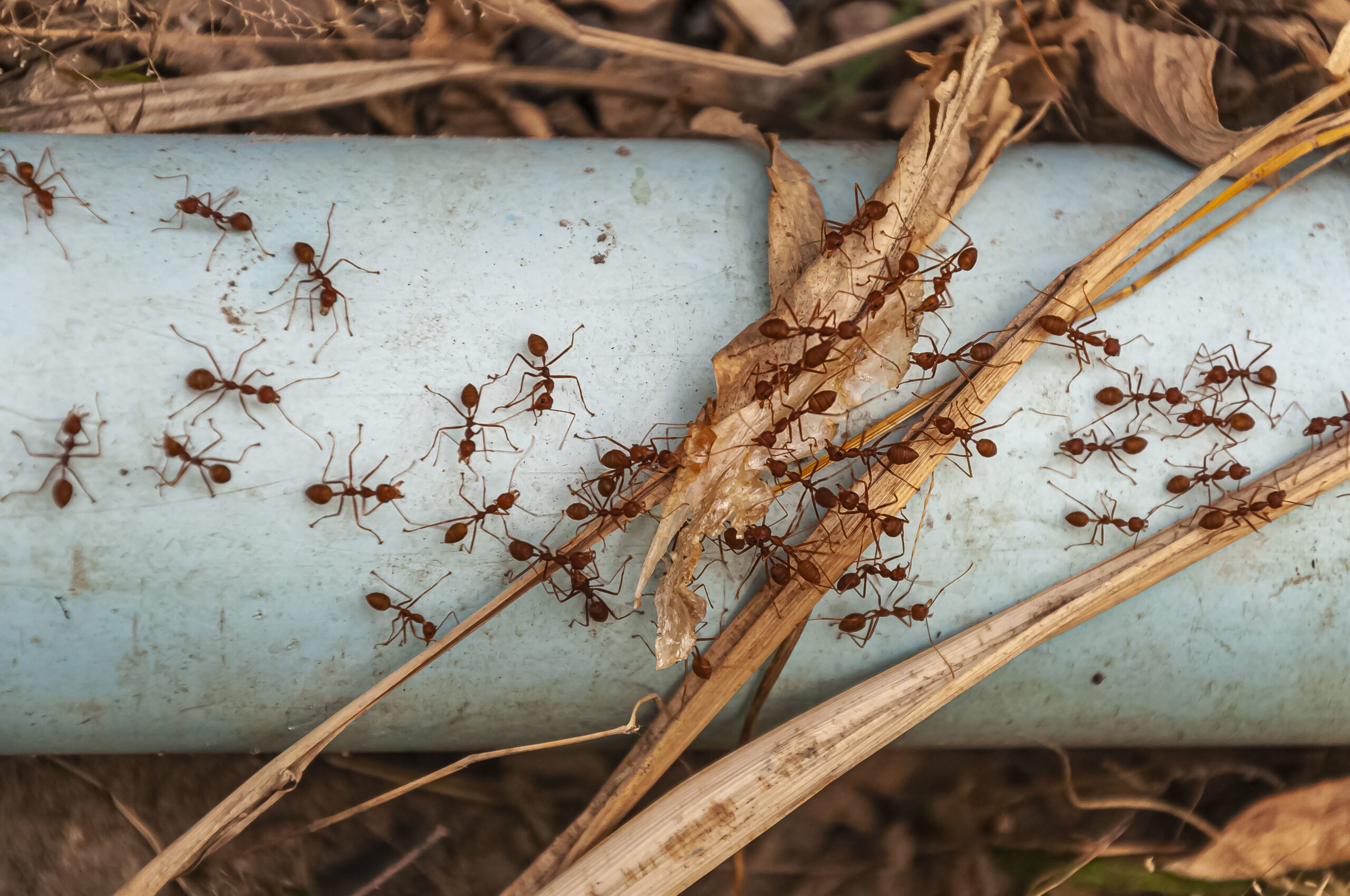
Fire Ants are reddish-brown and aggressive when disturbed, with stings that cause pain and allergic reactions. They typically nest outdoors but enter Singapore homes regularly through garden access points.
Black House Ants are small, intensely black, and more nuisance than serious threat — commonly trailing along skirting boards and counters in search of sweet food.
What Attracts Ants to Your Home?
Cockroaches are not a sign of poor housekeeping — and neither are ants. They are opportunists who will exploit whatever is accessible, regardless of how clean your home appears on the surface. Three things bring them in every time.
Food is the primary draw. A few scraps under the toaster, grease on the cooktop, dishes in the sink all night, or a loosely closed packet in the pantry is all it takes. The instant a scout finds something, it lays a pheromone shadow back to the nest, signalling thousands of settlement mates precisely where to go.
Moisture keeps them alive. Leakage pipes, condensation behind the icebox, damp bathroom angles, and water in plant trays all provide what ants need to exist. In many Singapore homes, fixing a single slow escape diminishes ant activity significantly within days.
Warmth and shelter perfect the picture. Appliance heat, undisturbed cardboard packages, and cluttered depots create warm, dark breeding atmospheres where colonies grow silently for weeks before anyone notices.
Signs of an Ant Infestation
- Visible ant trails — a constant, purposeful line moving between a food root and a wall gap or device
- Repeated sightings in the same spot despite cleaning, suggesting an active nest close by
- Small soil or debris piles near skirting boards indicate active nesting
- Sawdust-like frass near wooden structures — the clearest Carpenter ant portent sign
- Swarming winged ants indoors — conceptive members sent out to start new colonies, marking a mature, expanding colony
- Faint rustling inside walls — sometimes audible when a large Carpenter ant colony is actively excavating timber
How to Find an Ant Nest in Your House
Finding the nest is the most critical step in any ant infestation control strategy. Killing foraging workers without locating the colony is a temporary fix — the colony simply produces replacements indefinitely.
The most reliable method is to follow the trail patiently in both directions without spraying it. Trails almost always lead back to the nest if traced carefully. Common nest locations in Singapore homes include inside wall voids and hollow skirting boards, beneath kitchen and bathroom flooring, inside cavities behind electrical outlets, under and behind kitchen appliances, in the soil of potted plants, inside timber structures for Carpenter ants, and within ceiling cavities in landed properties.
Natural Ant Repellent Methods
Peppermint and Tea Tree Oil interfere with ants’ chemical communication. Mix 10 to 15 drops with two cups of water and spray along skirting boards, door thresholds, and visible trails. Reapply every two to three days for a consistent effect.
White Vinegar in a one-to-one mixture with water kills ants on contact and leaves a residue they detect and avoid. It doubles as an effective surface cleaner — a practical daily kitchen habit.
Cinnamon and Lemon Juice work as natural ant repellent barriers at entry points. Cinnamon powder or oil deters ants from crossing treated surfaces. Lemon juice contains D-limonene, naturally toxic to ants, and works well when sprayed around windowsills and door frames.
Boric Acid and Sugar Mixture is one of the most effective natural ant colony removal approaches. Workers carry the sweet mixture back to the nest where it gradually eliminates the population from within — including the queen. Keep away from children and pets.
21 Ways to Get Rid of Ants
Food and Environment Control
- Wipe all kitchen surfaces every night without exception
- Store all food, including pet food, in airtight containers
- Empty rubbish bins in sealed bags daily
- Clean behind and under kitchen appliances monthly
- Fix all plumbing leaks immediately
- Remove standing water from plant trays and drain dishes
- Keep compost bins sealed and away from the home
- Rinse food containers before placing them in recycling
Physical Barriers and Exclusion
- Seal gaps around pipes with silicone caulk
- Close cracks along skirting boards and window frames
- Fit door sweeps on exterior doors
- Install mesh screens over vents and drainage openings
- Keep garden vegetation trimmed away from exterior walls
Natural Ant Repellent Applications
- Spray peppermint or tea tree oil along trails every two to three days
- Sprinkle cinnamon powder at doorways and windowsills
- Spray a white vinegar and water mixture on surfaces daily
- Place coffee grounds along skirting boards and entry points
Targeted Treatment
- Place ant bait traps on active trails and leave undisturbed for at least one week
- Apply boric acid and sugar bait near trails — away from children and pets
- Dust diatomaceous earth along skirting boards and inside cabinet bases
- Apply commercial ant gel bait in small dots inside cabinet hinges and under appliances
Ant Bait Traps — Why They Work Better Than Sprays
Ant bait traps are consistently the most effective DIY ant infestation control tool available — and they work on a fundamentally different principle from contact sprays. Rather than killing ants immediately, ant bait traps use slow-acting poison mixed with an attractive food source. Workers carry it back and share it through the colony — including the queen — gradually collapsing the entire population from within.
The key is patience and correct placement. Put ant bait traps directly on active trails and never spray nearby — contact insecticide kills workers before they can deliver the bait to the nest, making the whole approach ineffective.
Different species need different bait types. Ghost ants and Pharaoh ants prefer sweet gel baits. Carpenter ants and Fire ants respond better to protein-based formulations. Getting this wrong significantly reduces effectiveness — which is why professional-grade ant bait traps used by PestPro consistently outperform consumer versions. They are specifically formulated for the ant species most prevalent in Singapore’s environment and produce visible colony decline significantly faster.
Conventional Control Methods
When natural repellents and ant bait traps are not sufficient, conventional chemical ant infestation control methods deliver faster and more comprehensive results.
Contact Insecticide Sprays kill ants immediately on treated surfaces and leave a short-term residual film. Useful for quick knockdown of visible trails, but they do not reach the nest and should never be used near active bait stations.
Residual Perimeter Sprays applied along skirting boards and around entry points create a chemical barrier that kills ants crossing treated zones for several weeks. Particularly effective for Fire ant control around Singapore landed properties.
Insecticidal Dusts, including professional boric acid formulations, are applied inside wall voids and behind electrical outlet boxes — areas inaccessible to liquid sprays. They provide long-lasting residual activity in harbourage areas and work particularly well for Carpenter ant treatment inside timber structures.
Professional Gel Bait is the conventional method of choice for Pharaoh and Ghost ant infestations in Singapore. Applied in precise micro-dots at harbourage locations, professional-grade gel achieves colony-collapse effects typically within one to two weeks of correct application — significantly faster and more reliably than consumer alternatives.
Carpenter Ant Special Considerations
Carpenter ants deserve separate attention because they behave differently from every other species — and the consequences of mishandling an infestation can be genuinely costly in Singapore’s landed properties.
The critical point is that Carpenter ants do not eat wood — they excavate it to create smooth-walled nesting galleries inside beams, door frames, window frames, and wooden furniture. By the time most homeowners discover an infestation, the excavation is already well advanced. The first visible sign is usually frass — a fine, sawdust-like material pushed out of the galleries as ants work. Finding frass near wooden structures is a signal to act immediately.
PestPro strongly advises any homeowner who suspects Carpenter ants to arrange a professional inspection promptly. Structural repair costs from a neglected infestation consistently far exceed the cost of early professional treatment.
When to Call a Professional
- Ants returning consistently after two to three weeks of DIY treatment
- Infestation spreading to multiple rooms or floors
- Pharaoh ant infestation confirmed — spraying makes it significantly worse
- Frass or damage indicating Carpenter ant activity in timber elements
- Winged ants swarming indoors, indicating active colony expansion
- Food business requiring NEA compliance
PestPro offers complete professional ant colony removal using commercial-grade slow-acting gel baits, residual insecticidal treatment, professional ant bait traps, monitoring stations, targeted nest treatment injected directly into colony sources, and Carpenter ant specialist treatment. Sessions range from one to two visits for light infestations, two to three sessions for moderate cases, and extended programmes of six to eight weeks for Pharaoh and Carpenter ant infestations.
All PestPro technicians are fully NEA-certified, and every treatment begins with a thorough inspection to identify species, locate nesting areas, and build a targeted treatment plan.
Prevention Tips — Keeping Ants Out for Good
Getting rid of ants is one thing. Keeping them gone requires consistent habits rather than occasional reactive treatments.
Daily food hygiene is the foundation. Wipe surfaces every night, store food in airtight containers, fix moisture sources immediately, and take rubbish out sealed before bed. These habits remove the reasons ants have to keep returning far more effectively than any spray.
Seal your home properly. Use silicone caulk on gaps around pipes, skirting board joints, and electrical fittings every six months. In HDB flats, shared wall junctions and floor drain covers are priority points — they are the most common routes through which ants migrate from neighbouring units.
Maintain ant bait traps as a permanent low-level monitoring measure in the kitchen. A single station in a high-risk area catches new scout activity before it develops into a full trail, and costs significantly less than treating an established infestation.
Conclusion
Ants are one of the most common pest complaints across Singapore — and one of the most consistently mishandled. Spraying the trail feels productive but rarely solves the real problem. The right approach is methodical: identify the species, locate the nest, remove food and moisture sources, and apply the correct treatment — whether that is natural ant repellent for deterrence, ant bait traps for colony-wide elimination, conventional insecticidal treatment for faster knockdown, or professional ant colony removal by PestPro for established infestations that DIY simply cannot reach.
Let PestPro Singapore find it — and finish it for good.
Frequently Asked Questions
Place ant bait traps on every active trail and remove all food and moisture sources simultaneously.
Because the colony is still intact. Surface sprays kill workers but never reach the queen — so the colony keeps producing replacements.
Peppermint oil, tea tree oil, white vinegar, cinnamon, and lemon juice all work as natural ant repellents. Apply consistently every two to three days at entry points and along trails for best results.
Follow the trail patiently without spraying it. Common nest locations include wall voids, under flooring, behind electrical outlets, inside timber structures, and under kitchen appliances. If the nest cannot be located, PestPro uses targeted inspection techniques to find hidden colonies.
Yes — ant bait traps are among the most effective ant infestation control methods available because they target the entire colony from within. Professional-grade baits used by PestPro outperform consumer versions significantly for the ant species most common in Singapore.