
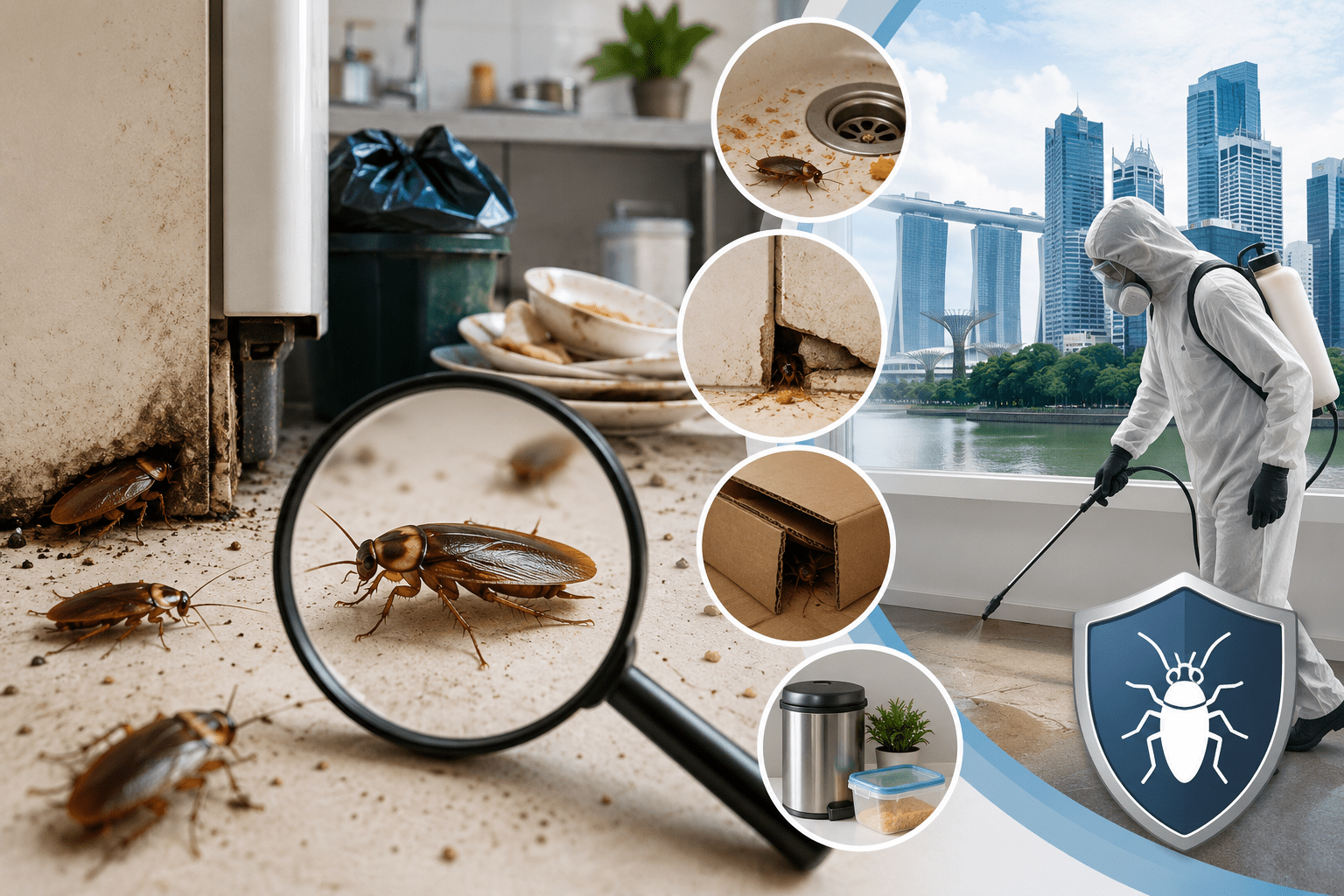
Cockroach Infestation Singapore
Late at night, you go to the kitchen for water. You turn the light on. Something moves fast along the wall and disappears behind the fridge.
Could be nothing. Probably isn’t.
That’s usually how a cockroach infestation in Singapore starts. Not with a swarm. Just one. Then droppings near the stove you didn’t notice before. A smell near the sink you can’t quite place. A second one, then a third. By the time it’s clearly a problem, they’ve been settled in your home for weeks already.
Singapore genuinely suits them. The heat never really breaks. Humidity stays up most of the year. HDB blocks share pipes, bin chutes, and wall gaps across dozens of units. One neighbour’s problem can quietly become yours without either of you doing anything wrong.
Pest-Pro handles cockroach jobs across Singapore every week, homes, restaurants, offices, warehouses. If you want to understand what’s going on and what actually fixes it, this is where to start.
Table of Contents
- We can help you get rid of Cockroach , fast.
Why Cockroach Infestations Are So Common in Singapore
It’s not about cleanliness, though that plays a part. It’s mostly about conditions.
Singapore sits in a tropical climate where temperatures and humidity stay consistently high all year. Cockroaches are cold-blooded insects that slow down in cold weather. There is no cold weather here. They breed, feed, and spread at full pace every single month.
The housing density makes it worse. In HDB blocks especially, plumbing, electrical conduits, and bin chutes connect unit to unit across the whole building. A cockroach infestation in Singapore can travel from one flat to another through gaps around shared pipes without ever going through a door. Your kitchen can be spotless and you can still end up with cockroaches because of what’s happening two floors up.
German cockroaches, which are the most common indoor species here, also reproduce at a rate that catches people off guard. One female produces several egg cases in her lifetime, each with around 30 to 40 eggs. A small problem ignored for a month or two becomes a large one. The numbers compound fast.
Types of Cockroaches You’ll Find in Singapore
Different species behave another way. Where they cover, how they move, what treatment works on them, none of this is the same throughout species. Naming what you’re dealing with before treating is the beginning point.
German Cockroach
Small, light brown, unbelievably fast. This is the species backside, most indoor infestations in Singapore, notably in kitchens and bathrooms. They nest near food and moisture, love tight enclosed areas, and breed faster than any other species usually found here. A cockroach infestation in Singapore that’s focused in the kitchen is almost always German cockroaches.
American Cockroach
Observably bigger and reddish-brown. These arise from drains, sewers, and outdoor zones. You’ll find them near bins, in basements, and in ground-floor units near outflow. They’re not nesting in your pantry. They’re approaching from the outside.
Oriental Cockroach
Dark brown, slower-moving, found in damp, cool spaces. Drains, laundry areas, and under sinks in bathrooms. Less pushy than German cockroaches, but still a worry.
Brown-Banded and Australian Cockroaches
Less frequently seen but not extraordinary. Brown-banded cockroaches are found in warmer, drier spots high up in cabinets, within appliances, and occasionally in electronics. Australian cockroaches choose outdoor vegetation and tend to come in accidentally.
Signs You’re Dealing With a Cockroach Infestation
Cockroaches at night – Turning lights on after dark and watching them spread is the clearest sign. One from time to time might mean a stray. Regularly means more.
Droppings – German cockroach excrement looks like ground black pepper. American cockroach droppings are larger, more cylindrical. Check the back of kitchen bloomers, inside cabinet door hinges, and along the base of the wall behind equipment.
Musty smell in enclosed spaces – A cockroach infestation in Singapore produces a distinct smell. Moderately oily, a bit stale. You’ll notice it most in cabinets that don’t get unlocked often or backside appliances.
Egg cases – Brown, capsule-shaped objects, roughly the size of a small bean. German cockroach cases are often fixed to surfaces inside cabinets or folded into tight corners. Finding these means reproduction has previously happened.
Smear marks – In humid areas, cockroaches leave dark smear marks along the surfaces they travel frequently. Behind the fridge, along the bottom of the walls near the water, around drain entrances.
See two or more of these? The infestation is already established and it won’t go away on its own.
What’s Actually Causing the Problem
Food That’s Too Easy to Reach
Cockroaches don’t need much. Crumbs under the toaster, grease on the stovetop, residue around the bin, pet food left out. German cockroaches have been documented eating soap, paper glue, toothpaste. The bar is low. If something has any nutritional value and it’s accessible, they’ll find it.
Moisture
Damp conditions matter as much as food. A slow drip under the kitchen sink, condensation pooling near the air-conditioning unit, wet areas in the bathroom that don’t dry out properly. Cockroaches need water to survive. Persistent moisture sources in hidden areas are a big part of why some homes keep having problems even after treatment.
Clutter and Tight Spaces
Cockroaches exhibit thigmotropism — they instinctively want surfaces touching their body from above and below simultaneously. Tight, dark, enclosed spaces feel safe to them. Cardboard boxes stacked in the storeroom, old newspapers, items crammed under the sink, rarely moved furniture. All of this is nesting habitat.
Rubbish and Waste
Bins without lids or bags that aren’t tied properly. Food scraps left in the sink drain. Recyclables with food residue sitting in a pile. In HDB flats, the bin chute area is one of the main routes cockroaches use to move between floors.
Shared Infrastructure in Singapore Buildings
This one is particular to how Singapore is built. In HDB blocks and older shophouses, pipes, conduits, and structural gaps connect unit to unit. A cockroach infestation in Singapore in one unit can migrate through these shared routes even when the affected unit itself is clean. This is why individual treatment sometimes isn’t enough without coordinated management of the building.
The Health Side of It
Cockroaches convey bacteria picked up from drains, sewage, rubbish, and decaying material. They walk throughout food preparation surfaces, utensils, and food itself. The diseases connected to cockroach contamination contain salmonella, diarrhoea, dysentery, cholera, and typhoid fever.
They also regularly regurgitate digestive fluid while feeding, which contaminates food even without evident droppings nearby.
For people with allergies or asthma, cockroach droppings, shed skin, and saliva are allergens. Children and elderly people are especially affected. Families living with an ongoing cockroach infestation in Singapore report increases in asthma attacks and skin reactions, often without linking it to the cockroach problem.
It’s truly a health issue. Not just an aesthetic one.
Where They’re Actually Hiding
This is where people searching the obvious places go wrong. Cockroaches aren’t usually where you’d look first.
Kitchen cabinets and behind appliances – The motor housing of a fridge runs warm constantly. The underside of a microwave holds food residue. The gap between the cabinet and the wall, the back corners of deep shelves. These are prime nesting spots.
Under sinks and around pipes – The space behind the pipes where they enter the wall, the underside of the drain, the cabinet floor under the sink. Damp, dark, undisturbed.
False ceilings and wall cavities – In older properties and commercial spaces especially. Cockroaches move freely through these spaces and emerge wherever there’s an opening.
Bin chute areas in HDB flats – The chute opening and the area immediately around it. American cockroaches use this route consistently.
Electrical appliances and panels – Cockroaches are attracted to warmth. TV units, set-top boxes, desktop computers, control panels. All provide heat and darkness.
Storerooms – Rarely disturbed, full of cardboard and clutter, often slightly damp. One of the most overlooked areas.
What to Do When You Notice a Problem
Don’t ignore a single cockroach. Specifically, if you see it during the day, cockroaches are nocturnal, and daytime action often means the hiding marks are getting crowded.
Look in the actual hiding spots. Torch, back of cabinets, under the sink, backside of appliances. You’re verifying for droppings, egg cases, smear signs, and live insects. What you find tells you how critical it is.
Clean up food access immediately. Wipe surfaces, seal food in containers, fix any sopping taps. This will not fix an infestation, but it slows them downhearted.
Don’t spray randomly. Off-the-shelf aerosols kill cockroaches on contact. They also spread the rest, driving them deeper into the property where they’re stronger to treat. It often makes the infestation harder to decide properly.
Call Pest-Pro. For anything above a very occasional stray, expert cockroach pest control in Singapore is the step that genuinely fixes it. Our team determines the species, finds the nesting sites, and applies treatment that targets the community. Not just what’s visible. Call 6300 8385 or get a quote here.
Our blog post on how to get rid of cockroaches in Singapore covers early-stage steps in more detail if you want to understand your options before calling.
How Pest-Pro Handles Cockroach Control
Inspection and Species ID First
Before any product goes down, our technician identifies what species is present. This changes everything — where we look, how we treat, what products we use. Skipping this step is why generic treatments often don’t stick.
Finding Entry Points and Nesting Areas
Where are they coming in from? Where are they nesting? These questions get answered through the inspection. Entry points, nesting locations, and movement patterns within the property all inform the treatment plan.
Treatment — the Right One for the Situation
Gel baiting — The standard approach for German cockroach infestations in homes and commercial kitchens. A bait gel placed in small amounts in precise locations where cockroaches travel. They eat it, go back to the nest, and pass it to others. It works on the whole colony, not just the ones you can see. Odourless and low-toxicity. No need to vacate the premises.
Residual spraying — Applied to surfaces cockroaches move across. The residue stays active for a period and kills insects that contact it. More commonly used for American cockroaches and larger infestations.
Granular baiting — Used mainly in outdoor areas and around drains to intercept cockroaches before they enter the building.
Insect growth regulators — Disrupt reproduction and development. Used in combination with other methods for serious or recurring infestations.
Follow-Up
One treatment isn’t always enough, especially for German cockroach infestations that are well-established. Pest-Pro follows up to check whether the treatment has worked and adjust if needed. This is the step a lot of cheaper services skip, and it’s often the difference between a fixed problem and a recurring one.
DIY Prevention — What’s Worth Doing
These don’t fix an active infestation. But they do reduce the chances of one starting, or coming back after treatment.
Seal gaps and cracks. Along skirting boards, around pipes where they enter walls, under doors. Even small gaps are usable. A proper sealant makes a real difference.
Keep the kitchen dry and clean. Wipe surfaces after cooking. Clean the stove regularly including the area underneath and behind it. Fix leaks promptly. Don’t leave dishes in the sink overnight.
Store food properly. Airtight containers for anything that isn’t sealed packaging. Pet food too, which gets left out overnight more often than people realise.
Throw rubbish out regularly. Sealed bags, properly closed bins, rinsed recyclables. In HDB flats, don’t leave rubbish near the bin chute opening.
Clear the storeroom. Old cardboard especially. If you haven’t opened a box in six months, check what’s living in it.
Why Cockroach Infestations Are Genuinely Hard to Eliminate
People underestimate this consistently.
The reproduction rate. A German cockroach female produces egg cases roughly every few weeks. Each case has 30 to 40 eggs. If you treat and get 80% of the population, the remaining 20% continues reproducing and you’re back to a serious cockroach infestation in Singapore within months.
Chemical resistance. German cockroaches have developed resistance to a number of common insecticides over decades of exposure. Products that worked reliably ten years ago are less effective now. This is part of why rotating treatment methods and using professional-grade products matters.
Hidden nesting. Treatment only works where it reaches. Nests inside walls, behind false ceilings, deep in appliances — standard surface sprays don’t get there. Gel baiting works better precisely because cockroaches carry it back to places products can’t reach directly.
Shared building infrastructure. In HDB settings especially, treating one unit while the adjacent unit has an active infestation means reinfestation through shared pipes and walls. This is a structural problem, not just a product problem.
For more detail on what makes cockroaches a serious concern beyond just being unpleasant, our blog post are cockroaches dangerous goes into the health picture specifically.
Residential vs Commercial — Different Properties, Different Problems
HDB flats and condos — Mostly German cockroaches in kitchens and bathrooms, American cockroaches from bin chutes and drains. Gel baiting works well here. Minimal disruption, no strong odours, safe with people in the home.
Landed homes — More entry points, more outdoor access. Both indoor and outdoor species can be issues. Usually a combination of indoor gel baiting and outdoor perimeter spraying.
Restaurants and F&B businesses — High-risk environment. Constant food, warm kitchens, frequent deliveries bringing cockroaches in via packaging and boxes. A cockroach infestation in Singapore in a food business can trigger NEA action and serious reputation damage fast. Pest-Pro builds maintenance schedules for F&B clients, not just one-off visits.
Offices — Usually centred around pantry areas. Easier to manage than food businesses but still needs proper treatment, not just gel traps from the hardware store.
Warehouses — Incoming stock is a major introduction route. Cardboard, pallets, and packaging bring cockroaches in regularly. Ongoing monitoring keeps it manageable.
Pest-Pro’s general pest control service covers all these property types with treatment plans that fit the specific situation rather than a generic package.
How Much Does Cockroach Pest Control Cost in Singapore?
No honest answer without knowing the property and the infestation. Here’s what actually changes the price:
Severity — A light infestation caught early in a kitchen is a smaller job than a heavy one that’s spread to multiple rooms over months.
Property size — More space means more potential nesting areas to inspect and treat.
Treatment type — Gel baiting for a contained German cockroach problem is priced differently from a combined treatment approach with residual spraying, granular baiting, and follow-up visits.
Ongoing vs one-time — Commercial clients especially benefit from maintenance schedules. These are priced differently from single visit treatments.
Pest-Pro gives a specific quote after seeing what’s there. Call 6300 8385 or request a quote online.
Emergency Cockroach Control in Singapore
Some situations genuinely can’t wait.
A restaurant that’s just had an NEA inspection flagging cockroach activity. A food production facility where the problem has been raised by staff. An office where the infestation is visible enough that it’s affecting work. A home where it’s gotten severe enough that people don’t want to use the kitchen.
Pest-Pro’s 24-hour hotline is 6300 8385. We move quickly when it’s urgent. For commercial properties, a cockroach infestation in Singapore that isn’t resolved fast creates regulatory, reputational, and operational problems that compound daily.
Low-Toxicity and Eco-Friendly Cockroach Control
Pest-Pro uses targeted, low-toxicity approaches wherever the situation allows. Gel baiting — the main treatment for German cockroach infestations in homes and food businesses — is odourless, applied in small precise amounts, and has minimal exposure risk for people and pets.
We don’t default to fogging an entire property. That approach saturates areas with chemicals, disrupts households, and is less effective than targeted treatment because cockroaches in wall voids and appliance housings simply aren’t reached by fog.
All products Pest-Pro uses are approved for Singapore and selected for both safety and effectiveness. The Anticimex connection means we follow international standards, not just local minimums.
Why Professional Cockroach Pest Control Makes More Sense Than DIY
Supermarket products kill individual cockroaches. They don’t kill the colony. You can go through a can of spray every week and still have the same infestation a month later because the nest is completely undisturbed.
Professional cockroach pest control in Singapore works differently. The right treatment for the right species, applied where the cockroaches actually are, targets reproduction and the colony itself. The results are different because the approach is different.
Species identification matters here too. Treating a German cockroach infestation with methods designed for American cockroaches wastes time and money and doesn’t resolve anything. Pest-Pro identifies before treating, every time.
Why Pest-Pro for Cockroach Infestation Singapore
Pest-Pro is part of Anticimex, one of the world’s largest pest management groups, around 5,000 specialists globally. In Singapore, that backing translates to access to current treatment technology, professional-grade products, and technicians trained to a proper standard.
What you get in practice: species identification before treatment, targeted low-toxicity methods, follow-up to confirm the infestation is resolved, clear pricing before work starts, 24-hour availability when it’s urgent.
Beyond cockroaches, Pest-Pro handles termite control, bed bug removal, mosquito management, rat and mice control, snake removal, ant control, and bird management. One company for the full range.
Call 6300 8385 or WhatsApp to get started.
FAQs – Cockroach Infestation Singapore
Climate is the main factor. Heat and humidity year-round create perfect breeding conditions. Dense housing with shared infrastructure means they spread easily between units. German cockroaches especially breed fast and thrive in Singapore's indoor environments.
Droppings near food preparation areas, egg cases tucked inside cabinets, a musty smell in enclosed spaces, smear marks near water sources, and cockroaches seen at night when lights turn on.
Not automatically. But it's worth checking properly. A cockroach seen during the day is a bigger concern because they normally avoid light. Regular sightings mean more are present.
Food residue, moisture, clutter, and accessible entry points. German cockroaches in particular need very little. A damp area under the sink and a few crumbs is enough.
Yes. They carry bacteria from drains and rubbish and contaminate food surfaces. Linked to food poisoning, diarrhoea, dysentery, and more. Their shed skin and droppings are allergens that worsen asthma, especially in children.
By identifying the species, locating nesting areas, and treating the colony, not just what's visible. Gel baiting, residual spraying, granular baiting, and insect growth regulators are used depending on species and severity, followed by monitoring to confirm it's worked.
Depends on infestation severity, property size, and treatment type. Pest-Pro gives a specific quote after inspection. Call 6300 8385.
You can eliminate an infestation and keep conditions unfavourable for reinfestation. Prevention, proper sealing, cleanliness, and periodic professional monitoring are what maintain it long-term.
Yes. Pest-Pro uses low-toxicity methods. Gel baiting in particular is odourless and safe when properly applied. We'll advise specifically based on what's being treated and where.
The treatment visit is typically an hour or two. Gel baiting works over days to weeks as cockroaches carry it back to the nest. Follow-up confirms the colony is gone. Pest-Pro sets clear expectations based on what the inspection shows.