
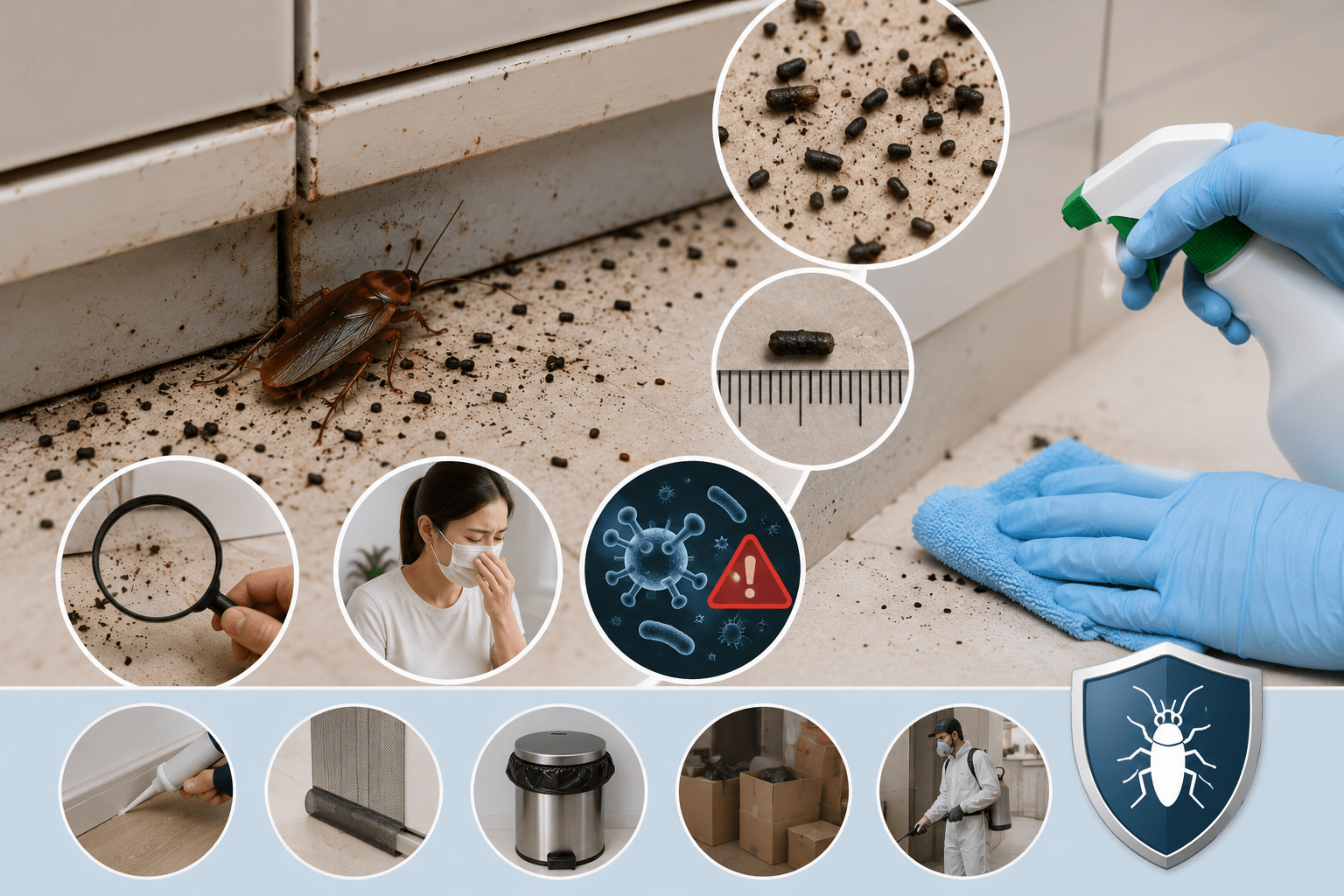
Cockroach Droppings – Identification, Risks and What to Actually Do About Them
People clean it up and move on. That’s the most common mistake Pest-Pro sees with cockroach droppings. Someone spots dark specks under the sink, wipes the shelf, and figures that’s that. Two months later the infestation is twice the size.
Cockroach droppings are not just a mess. They’re a signal that something is actively living in your walls, your cabinets, your appliances. And the longer that signal goes unread, the harder the problem gets.
Table of Contents
- We can help you get rid of Cockroach , fast.
What Are Cockroach Droppings?
- Cockroach droppings are small dark fecal particles left by roaches
- They look like black pepper (small roaches) or cylindrical pellets (large roaches)
- Found near food, moisture, and nesting areas
- A strong sign of active infestation
Why You Should Never Ignore Them
Roach faeces are the first thing most people find before they ever see an actual cockroach. That alone tells you something. These insects are nocturnal and very good at staying hidden, but they still leave behind waste wherever they feed and nest. And that waste shows up in places you open every day.
There’s another reason ignoring cockroach droppings makes things worse. The droppings contain pheromones chemical signals that tell other cockroaches this spot is safe and worth visiting. So a small accumulation of droppings left untreated isn’t a static problem. It actively draws more roaches in over time.
In Singapore homes, cockroach droppings are often the earliest sign of infestation. In over 80% of cases we inspect, visible droppings indicate hidden nesting inside cabinetry or wall voids.
What Do Cockroach Droppings Look Like?
Size matters here because Singapore has different cockroach species and they leave different roach droppings.
German cockroaches, the small ones that love kitchens and food prep areas, leave droppings that look like ground black pepper or very fine coffee grounds. Tiny. Dark. Usually found in clusters inside cabinet corners, along shelf edges, or near appliance bases.
American cockroaches, the bigger brown ones, leave larger cylindrical pellets. Blunt ends, sometimes with faint ridges running lengthwise. Dark brown to black. Roughly the size of a small grain of rice.
Both species also leave smear marks. Dark, irregular streaks along walls and surfaces where they travel repeatedly. These are more common in humid areas like under-sink spaces and bathroom cabinets. If you’re seeing smears rather than distinct pellets, the infestation is likely well established.
Cockroach Droppings vs Other Pest Droppings
Worth getting right before assuming anything.
Roach Droppings vs Rodent Droppings
Mouse droppings are larger and tapered at both ends, more like a small seed shape. Cockroach feces is smaller, more uniform, and usually found clustered near food or moisture rather than scattered along walls. If what you’re seeing is pointed and larger than a grain of rice, think rodents. Smaller, rounded, and grouped? More likely roaches.
Roach Droppings vs Lizard or Insect Waste
Lizard droppings have a white tip. Cockroach poop does not. That’s the simplest visual difference. Location helps too. Cockroach droppings are almost always found near food, water, or warmth. Lizard waste shows up more randomly, often near windows and entry points where insects come in.
Do Cockroach Droppings Have a Smell?
Yes, and it’s distinct once you’ve encountered it.
Musty. Slightly oily. In a small infestation you’d only smell it very close to the nest or a heavy activity spot. But as roach numbers grow, the smell spreads. Whole cabinets start carrying it. Some people describe walking into a kitchen and knowing something is wrong before they see anything.
Part of why it spreads is those pheromones again. The smell isn’t just unpleasant. It’s functional, from the cockroach’s point of view. It’s communication. And it works.
Where Are Cockroach Droppings Commonly Found?
The kitchen cabinet nearest the stove is almost always the first place Pest-Pro technicians check. That area has heat, food residue, and enough clutter to stay undisturbed. Nearly every kitchen cockroach infestation in Singapore leaves droppings in that spot.
After that, behind and under the refrigerator. Underneath and inside the microwave. The cabinet under the sink, especially around pipe fittings. Inside bathroom vanity units. Behind wall-mounted electrical panels. Basically, everywhere that’s dark, slightly warm, and doesn’t get washed constantly.
Can You Have Cockroach Droppings Without Seeing Roaches?
Easily. Most people with cockroach infestations in Singapore have never seen a live cockroach in their home.
They feed and proceed at night, generally between midnight and 4 am. By the time you’re in the kitchen in the morning, they’re already back inside the wall or the return of a cabinet. The only manifest they leave is the droppings, the smell, and, from time to time shed exoskeleton skins or egg cases.
Egg cases are worth watching for. Small brown capsule shapes, about 8 to 10mm long, are often stuck to surfaces with a sticky secretion. Ruling one means breeding is happening, not just searching.
Are Cockroach Droppings Dangerous?
Genuinely. Not just unpleasant. Actually dangerous.
Cockroach faeces carry bacteria, including Salmonella and E. coli. It lands on food prep surfaces, gets onto food packaging, dries and becomes airborne in enclosed spaces. Children and elderly family members are most vulnerable, but this is a health risk for anyone in the household.
The allergen angle is something people minimise. Cockroach droppings contain relief proteins that act as important allergens in indoor atmospheres. In Singapore’s climate, where windows stay closed and air conditioning recirculates indoor air, that exposure adds up. Research constantly links cockroach allergens to worsening asthma, specially in children.
Why Cockroach Droppings Indicate a Serious Infestation
A single cockroach doesn’t leave droppings across three kitchen cabinets.
The quantity and spread of droppings is a rough map of the infestation’s size and movement. A small cluster in one spot might be an early-stage problem. Droppings in multiple locations, heavy accumulations, smear marks on walls — that’s an established population with regular feeding routes.
And as mentioned before, the pheromones in those droppings keep compounding the problem. Untreated, the situation doesn’t stay stable. It grows.
How to Clean Cockroach Droppings Safely
Cleaning up roach droppings is necessary but it has to be done correctly. Dried cockroach feces releases allergen particles when disturbed. Dry sweeping it sends those particles into the air you breathe.
- Gloves on. Mask on. Non-negotiable.
- Vacuum the area first using a vacuum with a HEPA filter. Standard vacuums recirculate particles.
- Spray an antibacterial or bleach-based disinfectant on the affected surface and leave it for a few minutes.
- Wipe clean with disposable cloths or paper towels.
- Bag everything — cloth, gloves, vacuum bag — and seal it before putting it in the bin.
- Wash hands thoroughly even after removing gloves.
Cleaning removes the droppings. It does not address what’s producing them.
What to Do After Finding Cockroach Droppings
Clean first, then investigate properly.
Check every cabinet near where you found the droppings. Pull out appliances. Use a torch in dark corners. Note how many locations are affected. Look for egg cases and shed skins alongside the droppings. Smell for that musty odour.
Then seal any obvious gaps — around pipe fittings, where cables enter walls, gaps behind cabinet kick boards. These are entry and travel routes.
If droppings are in more than two locations or the volume is significant, the job is beyond what surface cleaning and gap sealing will fix. The guide on how to get rid of cockroaches properly is worth reading before you decide on next steps.
Professional Pest Control Company of Cockroaches
Inspection and Infestation Mapping
Pest-Pro doesn’t start by spraying. The first step is a proper inspection — checking the locations where droppings, egg cases, and activity signs are found, and mapping out where the infestation is concentrated versus where it’s spreading.
Gel Bait and Residual Spray Treatment
Gel bait placed inside cabinet cavities and harborage areas gets carried back to the nest by feeding roaches, spreading through the population. Residual spray covers travel routes and entry points. Together these are far more effective than surface sprays that only hit what’s visible.
Source Elimination
Entry points get sealed. Moisture sources that attract cockroaches get flagged. Without dealing with the conditions that created the infestation, it tends to return.
Follow-Up
Pest-Pro schedules a return visit to confirm the treatment worked and deal with any secondary activity before it re-establishes.
Why DIY Cleaning Alone Won’t Solve the Problem
Cleaning cockroach droppings is necessary for hygiene. It won’t reduce the infestation by a single roach.
The colony lives inside your walls and behind your cabinets. Off-the-shelf sprays hit surfaces, not nesting sites. The egg cases are resistant to most products available without a professional licence. And roach populations rebuild quickly from a small remaining group.
If you clean and don’t treat the source, you’ll be cleaning again in two weeks. The Pest-Pro cockroach treatment actually looks like versus what people think it involves.
Cost of Cockroach Control Services
Depends on three things: how serious the infestation is, how big the property is, and what treatment method is needed.
A minor early-stage problem treated in one room costs considerably less than a full-unit treatment for a mature infestation. Some cases need two or three sessions spaced a couple of weeks apart to catch egg hatches after the first treatment.
Pest-Pro inspects before quoting. No flat packages applied regardless of what’s actually there. The general pest control service page covers the process and what’s included.
Eco-Friendly Cockroach Control Options
Gel bait treatments, which are Pest-Pro’s primary method, are low-toxicity and applied only in harborage areas rather than broadcast-sprayed across surfaces. Safe for households with children and pets.
Ask Pest-Pro directly when booking if this is a concern. The answer will be specific to your situation, not a generic reassurance.
How to Prevent Cockroach Droppings in Future
Keep kitchen areas dry after cooking. Store food in locked containers, not loose packets. Fix seeping taps and pipes as soon as you notice them. Cockroaches need moisture to flourish. Declutter warehouse areas and take rubbish out before bed, not in the morning.
Every few months, ten minutes of verifying under sinks and behind appliances catches problems early. Early treatment is always cheaper and faster than established.
Why Choose Pest-Pro for Cockroach Control
Because finding cockroach droppings in your home and wiping them up isn’t a solution. It’s postponing a solution.
Pest-Pro Singapore handles infestations properly — full inspection first, treatment based on what’s actually found, follow-up to confirm results. Not a standard spray-and-leave visit.
If you’re finding droppings regularly or in multiple spots, get in touch with Pest-Pro before a manageable problem becomes a significant one.
Frequently Asked Questions
Small roaches leave tiny black specks like ground pepper. Larger roaches leave small dark cylindrical pellets with blunt ends. Both found near food and water sources.
Yes. Salmonella, E. coli, and allergens linked to asthma. Real health risks, not just a hygiene concern.
Musty and oily. The smell intensifies with the size of the infestation.
Kitchen cabinets, behind appliances, under sinks, bathroom vanities. Dark warm spots that don't get cleaned often.
Very common. Cockroaches are nocturnal. Active infestation, no visible insects during the day is typical.
Gloves and mask, HEPA vacuum, disinfectant spray, dispose of everything sealed. Don't dry sweep.
Yes. Pheromones in cockroach feces signal safety to other roaches. Untreated droppings make the problem grow.
Bacteria degrades over time but allergen proteins in dried cockroach droppings can stay active for months.
Yes. Contaminated surfaces, airborne allergens from dried feces — both are genuine health risks.
When you find droppings in more than one location, or the same spot keeps showing droppings after cleaning. That's an active infestation, not a stray roach.